




In the 2019 ASQA Training Provider Briefing, Training and Assessment once again took the spotlight as one of the most common compliance issues with RTOs.
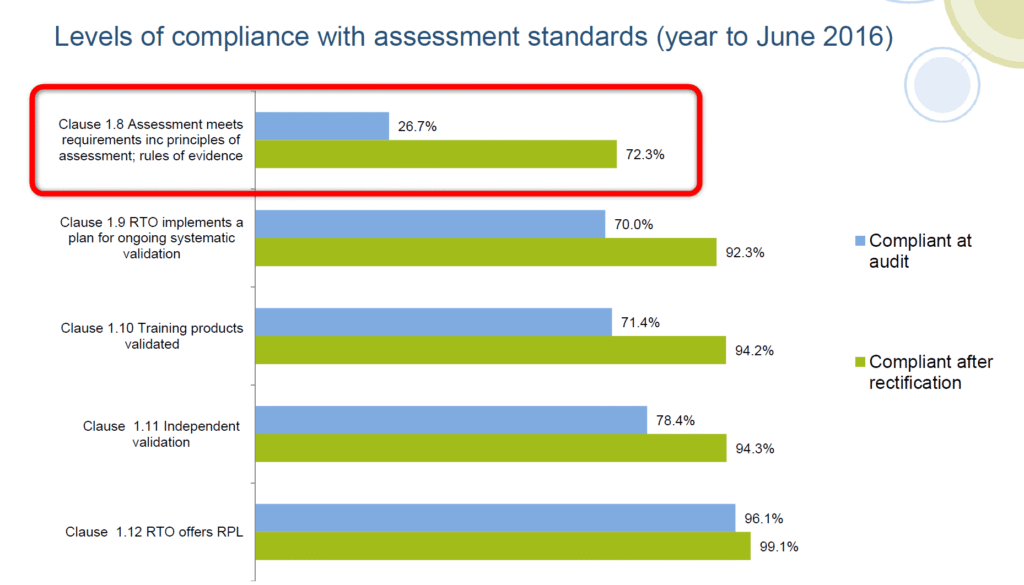
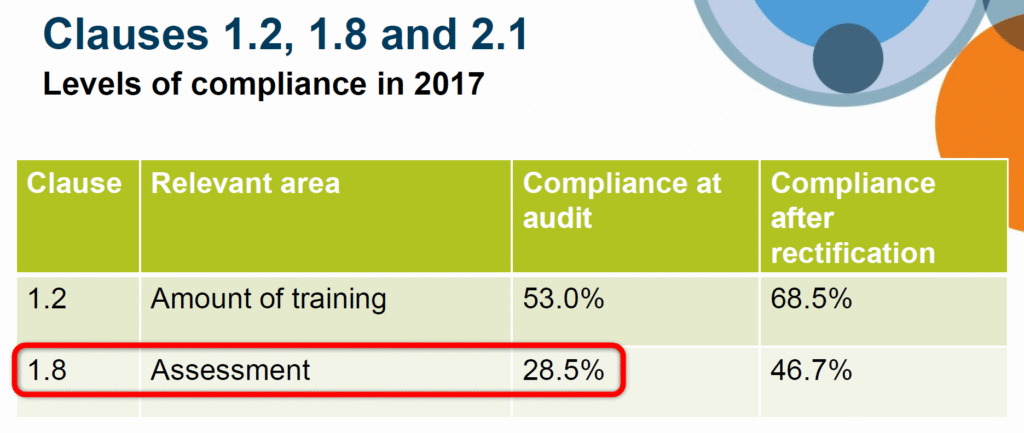
In 2016 and 2017, only less than 3 out of 10 RTOs met the requirements of Clause 1.8:
Although the briefings this year did not provide statistics, Training and Assessment remained as one of the top challenges for RTO compliance in 2018:
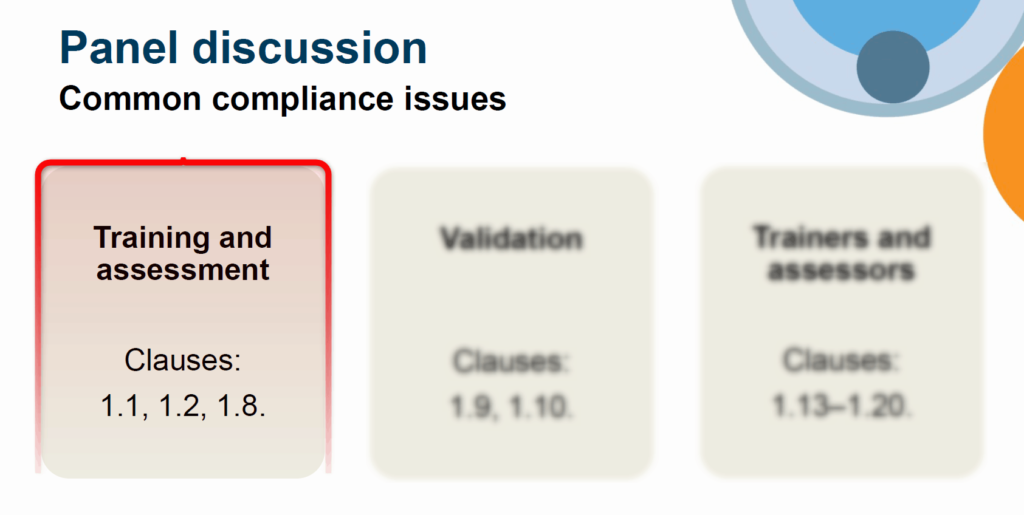
The reason this is so challenging is that Clause 1.8 has the biggest impact on the students, their community, and relevant industries.
For example, if you have issued a ‘Driving Dangerous Goods’ certificate to someone who did not meet the training package requirements for this course, you may be putting that student, their immediate community, and their industry at risk of accidents, and other financial and/or legal liabilities.
As a general rule, if you are found non-compliant in any of the clauses, you will be asked to do two things:
- Fix the non-compliance for your future students
- Provide remedial action for all your current and past students affected by the non-compliance
Depending on how big your scope of delivery is, doing this for clause 1.8 could take a lot of time, effort and resources to rectify. Fixing up the resources alone already takes a lot of time to do.
On top of that, remedial actions are also historically very challenging for RTOs to implement, particularly to RTOs delivering a wide range of courses to a big number of students. Remedial action strategies can vary from as simple as providing students updated information to as complex as requiring them to complete gap assessments (or even full reassessments), or even having to revoke their certificates altogether. As you can imagine, this could get very stressful for both the RTO and the students.
QUICK SELF-CHECK!
Are you at risk? Here are some of the most common assessment issues identified by ASQA during audits:
1. Practical skills are not assessed through practical demonstration
This is where assessments only ask students to talk about how to demonstrate a skill, instead of having students actually demonstrate them through performance. For example, asking students to list the steps of how to do CPR instead of having them actually do it.
2. Insufficient marking guide or assessment criteria
This is where assessments do not have clear guidance on what a Satisfactory Performance is. For example, when you see marking guides that are just copy-pasted from the unit of competency requirements, or when you see observation forms a that are just ‘tick and flick’ list of tasks without any clear guidance how the task must be completed.
3. Insufficient instructions for the learners and the assessors to carry out the assessment task
This is where the assessment instructions are not contextualised to the RTO’s delivery strategies. For example, if you intend to deliver the activities in the context of the classroom, the assessment tools must include instructions for the assessor how to facilitate this in the classroom. Alternatively, if the learners are supposed to complete the assessments in their own time, then the assessment tools must include detailed instructions for the learners how to do this.
4. Ineffective mapping
Although strictly speaking, ‘mapping’ is not an explicit requirement of the Standard, it is an excellent way to assist in demonstrating training package compliance. Ineffective mapping usually includes:
- Mapping elements and performance criteria only (not mapping Performance Evidence, Knowledge Evidence, Foundation Skills and Assessment Conditions)
- Over mapping (mapping all unit requirements to one task, or mapping all tasks to all unit requirements)
- Ineffective mapping (mapping to assessment instructions only; effective mapping must include mapping to the instructions, the marking guides, and the tools to document student performance and assessment outcomes)
5. Ineffective third-party observation tools
Here are several ways this happens:
- it is unclear who are qualified to be third-party observers
- it is unclear how to carry out the third-party observation
- the observation tool is ineffective in capturing the students’ performance (remember, the observer is only documenting the students’ performance, they are NOT making the assessment judgments)
- unqualified third-party observers are making the assessment judgments (only qualified assessors must make the assessment judgments)
If you find you are at risk with any of the above assessment issues, I highly recommend that you start addressing them ASAP. If you are not sure, get your assessments validated to find out.
The longer you leave these issues unchecked, the higher the risk and the bigger the rectification task will be for you when they are identified at an ASQA audit.
Remember: when you are on the audit rectification clock, you will have very limited time to get it all done – so the best time to start is now.
Stay tuned as our next blog will be on how to fix these pesky assessment issues.